This had to hurt
In a major decision for consumer transparency, an Administrative Law Judge has formally ruled that Tesla’s branding of “Autopilot” and “Full Self-Driving Capability” is misleading under California law. This decision, issued by Judge Juliet E. Cox on November 20, 2025, follows a long-running dispute between the California Department of Motor Vehicles (DMV) and Tesla regarding how the company markets its Advanced Driver Assistance System (ADAS) features.
FAs someone who has spent the last couple years advocating for myself and other Tesla owners and navigating the complexities of Tesla’s arbitration process, this ruling provides a powerful new foundation for holding the company accountable. At TeslaArbitration.com, I have consistently argued that there is a massive gap between the capabilities of the hardware delivered and the promises made by the company. This ruling validates that perspective on a state-wide legal level. It will likely have broader implications in legislatures, government regulatory agencies, courthouses and arbitration hearings across the country.
The Core Finding: Branding vs. Reality
The judge’s decision was blunt: Tesla’s marketing leads reasonable people to believe these vehicles are more capable than they actually are. Judge Cox determined that the names themselves are “inherently misleading” and violate the California Vehicle Code.
The ruling breaks down several key failures in Tesla’s marketing strategy:
- The “Autopilot” Illusion: The court found that the name “Autopilot” communicates a level of functionality commonly associated with autonomous driving that the feature set simply does not include. A reasonable person would likely believe the vehicle does not require constant, undivided attention while the system is in use.
- The “Full Self-Driving” Deception: The phrase “Full Self-Driving Capability” was found to be “actually, unambiguously false and counterfactual”. Despite the name, no vehicle Tesla sold between 2021 and 2024 was fully autonomous at the time of sale, nor has any become so through software updates. In my view, the judge took four words to explain a simple concept – led its customers to believe something that Tesla knew was untrue. Remember, no Tesla consumer vehicle is approved for anything greater than Level 2 autonomy.
- Ineffective Disclaimers: Tesla’s defense relied on the “fine print” found in owners’ manuals and pop-up warnings The judge rejected this, stating that disclaimers and qualifications cannot make an inherently deceptive name non-deceptive.
- Misleading Video Content: The judge highlighted a 2020 video on Tesla’s website, titled “The Future of Driving”, showing a person in the driver’s seat not touching the wheel while the car navigated urban areas. The court found this video implies current autonomous capability that does not exist. The video opened with this message – The video begins with a title screen that states “THE PERSON IN THE DRIVER’S SEAT IS ONLY THERE FOR LEGAL REASONS. HE IS NOT DOING ANYTHING. THE CAR IS DRIVING ITSELF.”
What This Means for Pending and Future Cases
I currently represent a number of Tesla owners who feel they were sold a bill of goods. This decision is not just a regulatory win; it will likely have a direct impact on the cases we are currently litigating and those we will file in the future.
In the past, Tesla has often tried to shield itself by blaming the driver for not “actively supervising” the car. However, this ruling establishes that the very terms used to sell the car were designed to mislead the consumer about the need for that supervision. The case for proving deception in individual arbitration cases has been materially strengthened.
Moving Forward
As a result of these findings, the judge has ordered a 30-day suspension of Tesla’s vehicle dealer and manufacturer licenses. A stay of this suspension is in place. While Tesla has already begun adjusting some language—such as renaming the suite “Full Self-Driving (Supervised)”—the legal precedent that their long-standing marketing was deceptive is now a matter of public record.
If you purchased a Tesla based on the promise of “Full Self-Driving” or “Autopilot” and feel the technology hasn’t lived up to the marketing, your rights have been strengthened. We are continuing to fight for restitution for owners who were misled by these “will” statements and aspirational branding.
An Interesting Historical Moment
In an interesting twist of irony, Elon Musk demonstrated a knowledge of marketing deception. In September 2019, Porsche announced its Taycan EV lineup to the world. One of the models would be designated “Turbo S”. Of course, as an electric car, a turbocharger is about as useful as naming my cat “Turbo”.
Elon Musk saw the humor, irony or perhaps even the deception in this. He immediately took to Twitter, which he did not yet own.
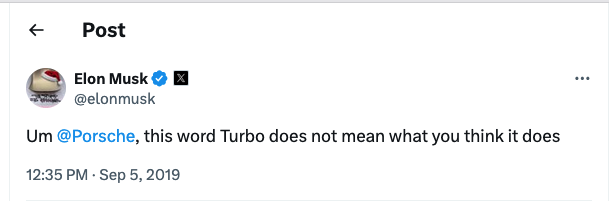
Maybe Porsche should write back and say “Full-Self Driving Capability” does not mean what you think it does?
The Really Interesting Point
What if a person bought a Tesla because of the Full Self Driving promise. What about the further promise of the privately-owned Tesla vehicles being used in some global autonomous taxi network? Don’t forget, Elon Musk said this –
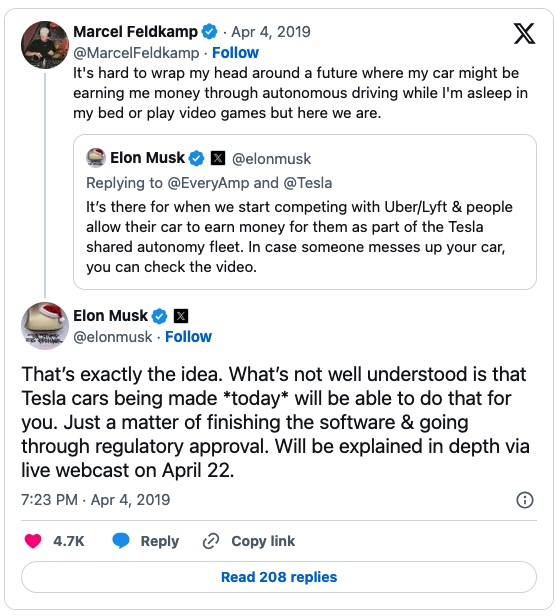
And then he said this –
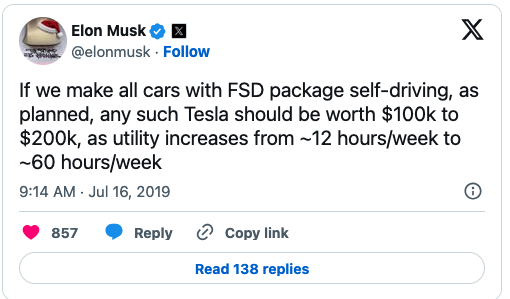
So here we are, 6 1/2 years later. The company that made fun of the Taycan “Turbo” moniker has not delivered on its promise of Full Self-Driving, has not delivered an autonomous vehicle fleet made up of private owners’ cars, has not seen its cars appreciate in value and now has had an administrative judge find that its marketing was false. That about sums it up.
Are you a Tesla owner dealing with Autopilot or FSD issues? You can read the ALJ’s decision here. Contact me today to see how this significant decision affects your potential claim.
Leave a Reply